Friday, 17 November 2017

Paper no. : 4 Assignment

To Evaluate my  Assignment


Assignment
Name : mori utsavi bharatbhai
Roll No : 44
Enrollment No. : 2069108420180037
M.A Sem-1
Year : 2017-2019
Email id : utsavibarajput18@gmai.com
Paper No. : 4
Submitted To. : Department of English bhavnagar
Topic :  Aurobindo was a social reformer

·       Introduction : ~                                      Aurobindo (Bengali: [Sri Ă”robindo]) (born Aurobindo Ghose; 15 August 1872 – 5 December 1950) was an Indian philosopher, yogi, guru, poet, and nationalist.[2] He joined the Indian movement for independence from British rule, for a while was one of its influential leaders and then became a spiritual reformer, introducing his visions on human progress and spiritual evolution.Aurobindo studied for the Indian Civil Service at King's College, Cambridge, England. After returning to India he took up various civil service works under the maharaja of the princely state of Baroda and began increasingly involved in nationalist politics and the nascent revolutionary movement in Bengal. He was arrested in the aftermath of a number of bomb outrages linked to his organisation, but in a highly public trial where he faced charges of treason, Aurobindo could only be convicted and imprisoned for writing articles against British rule in India. He was released when no evidence could be provided, following the murder of a prosecution-witness during the trial. During his stay in the jail he had mystical and spiritual experiences, after which he moved to Pondicherry, leaving politics for spiritual work. During his stay in Pondicherry, Aurobindo developed a method of spiritual practice he called Integral Yoga. The central theme of his vision was the evolution of human life into a life divine. He believed in a spiritual realisation that not only liberated man but transformed his nature, enabling a divine life on earth. In 1926, with the help of his spiritual collaborator, Mirra Alfassa (referred to as "The Mother"), he founded the Sri Aurobindo Ashram. He died on 5 December 1950 in Pondicherry. His main literary works are The Life Divine, which deals with theoretical aspects of Integral Yoga; Synthesis of Yoga, which deals with practical guidance to Integral Yoga; and Savitri: A Legend and a Symbol, an epic poem. His works also include philosophy, poetry, translations and commentaries on the Vedas, Upanishads and the Bhagavad Gita. He was nominated for the Nobel                        Prize in Literature in 1943 and for the Nobel Peace Prize in 1950.[3]


                Sri  Aurobindo

Social reformer of Aurobindo : ~               
          
            ~  Aurobindo was a Reform is not an excellent thing in itself as many Europeanised intellects imagine; neither is it always safe and good to stand unmoved in the ancient paths as the orthodox obstinately believe. Reform is sometimes the first step to the abyss, but immobility is the most perfect way to stagnate and to putrefy. Neither is moderation always the wisest counsel: the mean is not always golden. It is often an euphemism for purblindness, for a tepid indifference or for a cowardly inefficiency. Men call themselves moderates, conservatives or extremists and manage their conduct and opinions in accordance with a formula. We like to think by systems and parties and forget that truth is the only standard. Systems are merely convenient cases for keeping arranged knowledge, parties a useful machinery for combined action; but we make of them an excuse for avoiding the trouble of thought.
One is astonished at the position of the orthodox. They labour to deify everything that exists. Hindu society has certain arrangements and habits which are merely customary. There is no proof that they existed in ancient times nor any reason why they should last into the future. It has other arrangements and habits for which textual authority can be quoted, but it is oftener the text of the modern Smritikaras than of Parasara and Manu. Our authority for them goes back to the last five hundred years. I do not understand the logic which argues that because a thing has lasted for five hundred years it must be perpetuated through the aeons. Neither antiquity nor modernity can be the test of truth or the test of usefulness. All the Rishis do not belong to the past; the Avatars still come; revelation still continues.
Some claim that we must at any rate adhere to Manu and the Puranas, whether because they are sacred or because they are national. Well, but, if they are sacred, you must keep to the whole and not cherish isolated texts while disregarding the body of your authority. You cannot pick and choose; you cannot say “This is sacred and I will keep to it, that is less sacred and I will leave it alone.” When you so treat your sacred authority, you are proving that to you it has no sacredness. You are juggling with truth; for you are pretending to consult Manu when you are really consulting your own opinions, preferences or interests. To recreate Manu entire in modern society is to ask Ganges to flow back to the Himalayas. Manu is no doubt national, but so is the animal sacrifice and the burnt offering. Because a thing is national of the past, it need not follow that it must be national of the future. It is stupid not to recognise altered conditions.
We have similar apologies for the unintelligent preservation of mere customs; but, various as are the lines of defence, I do not know any that is imperiously conclusive. Custom is shishtachar, decorum, that which all well-bred and respectable people observe. But so were the customs of the far past that have been discontinued and, if now revived, would be severely discountenanced and, in many cases, penalised; so too are the customs of the future that are now being resisted or discouraged, — even, I am prepared to believe, the future no less than the past prepares for us new modes of living which in the present would not escape the censure of the law. It is the achar that makes the shishta, not the shishta who makes the achar. The achar is made by the rebel, the innovator, the man who is regarded in his own time as eccentric, disreputable or immoral, as was Sri Krishna by Bhurisrava1 because he upset the old ways and the old standards. Custom may be better defended as ancestral and therefore cherishable. But if our ancestors had persistently held that view, our so cherished customs would never have come into being. Or, more rationally, custom must be preserved because its long utility in the past argues a sovereign virtue for the preservation of society. But to all things there is a date and a limit. All long-continued customs have been sovereignly useful in their time, even totemism and polyandry. We must not ignore the usefulness of the past, but we seek in preference a present and a future utility.
Custom and Law may then be altered. For each age its shastra. But we cannot argue straight off that it must be altered, or even if alteration is necessary, that it must be altered in a given direction. One is repelled by the ignorant enthusiasm of social reformers. Their minds are usually a strange jumble of ill-digested European notions. Very few of them know anything about Europe, and even those who have visited it know it badly. But they will not allow things or ideas contrary to European notions to be anything but superstitious, barbarous, harmful and benighted, they will not suffer what is praised and practised in Europe to be anything but rational and enlightened. They are more appreciative than Occidentals themselves of the strength, knowledge and enjoyment of Europe; they are blinder than the blindest and most self-sufficient Anglo-Saxon to its weakness, ignorance and misery. They are charmed by the fair front Europe presents to herself and the world; they are unwilling to discern any disease in the entrails, any foulness in the rear. For the Europeans are as careful to conceal their social as their physical bodies and shrink with more horror from nakedness and indecorum than from the reality of evil. If they see the latter in themselves, they avert their eyes, crying, “It is nothing or it is little; we are healthy, we are perfect, we are immortal.” But the face and hands cannot always be covered, and we see blotches.
The social reformer repeats certain stock arguments like shibboleths. For these antiquities he is a fanatic or a crusader. Usually he does not act up to his ideas, but in all sincerity he loves them and fights for them. He pursues his nostrums as panaceas; it would be infidelity to question or examine their efficacy. His European doctors have told him that early marriage injures the physique of a nation, and that to him is the gospel. It is not convenient to remember that physical deterioration is a modern phenomenon in India and that our grandparents were strong, vigorous and beautiful. He hastens to abolish the already disappearing nautchgirl, but it does not seem to concern him that the prostitute multiplies. Possibly some may think it a gain that the European form of the malady is replacing the Indian! He tends towards shattering our cooperative system of society and does not see that Europe is striding Titanically towards Socialism.
Orthodox and reformer alike lose themselves in details; but it is principles that determine details. Almost every point that the social reformers raise could be settled one way or the other without effecting the permanent good of society. It is pitiful to see men labouring the point of marriage between subcastes and triumphing over an isolated instance. Whether the spirit as well as the body of caste should remain, is the modern question. Let Hindus remember that caste as it stands is merely jat, the trade guild sanctified but no longer working, it is not the eternal religion, it is not chaturvarnya. I do not care whether widows marry or remain single; but it is of infinite importance to consider how women shall be legally and socially related to man, as his inferior, equal or superior; for even the relation of superiority is no more impossible in the future than it was in the far-distant past. And the most important question of all is whether society shall be competitive or cooperative, individualistic or communistic. That we should talk so little about these things and be stormy over insignificant details, shows painfully the impoverishment of the average Indian intellect. If these greater things are decided, as they must be, the smaller will arrange themselves.
There are standards that are universal and there are standards that are particular. At the present moment all societies are in need of reform, the Parsi, Mahomedan and Christian not a whit less than the Hindu which alone seems to feel the need of radical reformation. In the changes of the future the Hindu society must take the lead towards the establishment of a new universal standard. Yet being Hindus2 we must seek it through that which is particular to ourselves. We have one standard that is at once universal and particular, the eternal religion, which is the basis, permanent and always inherent in India, of the shifting, mutable and multiform thing we call Hinduism. Sticking fast where you are like a limpet is not the dharma, neither is leaping without looking the dharma. The eternal religion is to realise God in our inner life and our outer existence, in society not less than in the individual. Esha dharmah sanatanah. God is not antiquity nor novelty: He is not the Manava Dharmashastra, nor Vidyaranya, nor Raghunandan; neither is He an European. God who is essentially Sachchidananda, is in manifestation Satyam, Prema, Shakti3, — Truth, Strength and Love. Whatever is consistent with the truth and principle of things, whatever increases love among men, whatever makes for the strength of the individual, the nation and the race, is divine, it is the law of Vaivaswata Manu, it is the sanatana dharma and the Hindu shastra. Only, God is the triple harmony, He is not one-sided. Our love must not make us weak, blind or unwise; our strength must not make us hard and furious; our principles4 must not make us fanatical or sentimental. Let us think calmly, patiently, impartially; let us love wholly and intensely but wisely; let us act with strength, nobility and force. If even then we make mistakes, yet God makes none. We decide and act; He determines the fruit, and whatever He determines is good.
He is already determining it. Men have long been troubling themselves about social reform and blameless orthodoxy, and orthodoxy has crumbled without social reform being effected. But all the time God has been going about India getting His work done in spite of the talking. Unknown to men the social revolution prepares itself, and it is not in the direction they think, for it embraces the world, not India only. Whether we like it or not, He will sweep out the refuse of the Indian past and the European present. But the broom is not always sufficient; sometimes He uses the sword in preference. It seems probable that it will be used, for the world does not mend itself quickly, and therefore it will have violently to be mended.
But this is a general principle; how shall we determine the principles that are particular to the nature of the community and the nature of the Age? There is such a thing as yugadharma, the right institutions and modes of action for the age in which we live. For action depends indeed on the force of knowledge or will that is to be used, but it depends, too, on the time, the place and the vessel. Institutions that are right in one age are not right in another. Replacing social system by social system, religion by religion, civilisation by civilisation God is perpetually leading man onwards to loftier and more embracing manifestations of our human perfectibility. When in His cosmic circling movement He establishes some stable worldwide harmony, that is man's Satya Yuga. When harmony falters, is maintained with difficulty, not in the nature of men, but by an accepted force or political instrument, that is his Treta. When the faltering becomes stumbling and the harmony has to be maintained at every step by a careful and laborious regulation, that is his Dwapara. When there is disintegration, and all descends in collapse and ruin, nothing can stay farther the cataclysm that is his Kali. This is the natural law of progress of all human ideas and institutions. It applies always in the mass, continually though less perfectly in the detail. One may almost say that each human religion, society, civilisation has its four Ages. For this movement is not only the most natural, but the most salutary. It is not a justification of pessimism nor a gospel of dumb fate and sorrowful annihilation. It is not, as we too often think in our attachment to the form, a melancholy law of decline and the vanity of all human achievements. If each Satya has its Kali, equally does each Kali prepare its Satya. That destruction was necessary for this creation, and the new harmony, when it is perfected, will be better than the old. But there is the weakness, there is the half success turning to failure, there is the discouragement, there is the loss of energy and faith which clouds our periods of disintegration, the apparent war, violence, ragging, tumult and trample to and fro which attends our periods of gradual creation and half-perfection. Therefore men cry out dismally and lament that all is perishing. But if they trusted in God's Love and Wisdom, not preferring to it their conservative and narrow notions, they would rather cry out that all is being reborn.
So much depends on Time and God's immediate purpose that it is more important to seek out His purpose than to attach ourselves to our own nostrums. The Kala Purusha, Zeitgeist and Death Spirit, has risen to his dreadful work — lokakshayakritpravriddhas — increasing to destroy a world, — and who shall stay the terror and mightiness and irresistibility of Him? But He is not only destroying the world that was, He is creating the world that shall be; it is therefore more profitable for us to discover and help what He is building than to lament and hug in our arms what He is destroying. But it is not easy to discover His drift, and we often admire too much temporary erections which are merely tents for the warriors in this Kurukshetra and take them for the permanent buildings of the future.
The Pandits are therefore right when they make a difference between the practice of the Satya and the practice of the Kali. But in their application of this knowledge, they do not seem to me to be always wise or learned. They forget or do not know that Kali is the age for a destruction and rebirth, not for a desperate clinging to the old that can no longer be saved. They entrench themselves in the system of Kalivarjya, but forget that it is not the weaknesses but the strengths of the old harmony that are being subjected to varjanam, abandonment. That which is saved is merely a temporary platform which we have erected on the banks of the sea of change awaiting a more stable habitation; and it too must one day break down under the crash of the waves, must disappear into the engulfing waters. Has the time arrived for that destruction? We think that it has. Listen to the crash of those waters, — more formidable than the noise of assault, mark that slow, sullen, remorseless sapping, — watch pile after pile of our patched incoherent ramshackle structure corroding, creaking, shaking with the blows, breaking, sinking silently or with a splash, suddenly or little by little into the yeast of those billows. Has the time arrived for a new construction? We say it has. Mark the activity, eagerness and hurrying to and fro of mankind, the rapid prospecting, seeking, digging, founding — see the Avatars and great vibhutis coming, arising thickly, treading each close behind the other. Are not these the signs and do they not tell us that the great Avatar of all arrives to establish the first Satya Yuga of the Kali?
For in the Kali too, say the secret and ancient traditions of the Yogins, there is a perpetual minor repetition of Satya-Treta-Dwapara-Kali subcycles, the subSatya a temporary and imperfect harmony which in the subTreta and subDwapara breaks down and disappears in the subKali.

Paper no . : 2 Assignment

To evaluate my Assignment
Click here

Assignment
Name : mori utsavi bharatbhai
Roll No. : 44
Enrollment No. : 2069108420180037
M.A.Sem-1
Year : 1017-2019
Email id : utsavibarajput18@gmail.com
Paper No.: 2. The neo- classical literatuur
Submitted to : department of English bhavnagar
Topic : critically analyze  the character of course.


·         Introduction :~
                       Daniel Defoe wrote Robinson Crusoe at the age of fifty-nine and it was an immediate success. The story of Robinson Crusoe that has delighted the young, and the old for that matter, for over two-hundred years was actually based on an experience in the life of a seaman, Alexander Selkirk, who spent four years on the deserted island of Juan Fernandez.But Selkirk's four years become thirty in Defoe's hands and the story itself is turned into a microcosm of the eighteenth


But Selkirk's four years become thirty in Defoe's hands and the story itself is turned into a microcosm of the eighteenth century's triumph over nature. During the thirty years of his stay on the island, Crusoe establishes himself very comfortably, converts his native servant Friday to Christianity, overcomes the savages and is hailed as their master. By the happy device of allowing Crusoe to rescue ammunition and material from his wrecked ship before the storm finally destroys it, Defoe is able to invest every moment of the life on the island with interest. Any withholding of belief was impossible when the reader was confronted with the thousand details of Crusoe's everyday activities-making a sieve, milking goats, preparing his food, and fortifying his home. Nothing was omitted that might delight the new reading public, eager for facts, enchanted by documentary records and demanding the illusion of truth.

The book is a kind of epic of human endeavour ceaselessly striving after some fresh comfort or betterment. Opinions differ as to the sincerity of the religious psychology; there can be no doubt as to the truth of the touches which indicate the desire for companionship. In the hierarchy of Crusoe's retainers, the parrot ranks first, because it can speak words. For sheer power of conveying a set of sensations, all writers agree that nothing can exceed the lonely man's sudden discovery of a footprint on the sand: yet the description of his landing through the surf, his flight before wave after wave, is hardly inferior. And for perfection and beauty of invention, one may cite the incident of corn blades springing up, as it first seemed, by unaccountable providence beside his cave. But like everything else that is recorded as happening to him, this seems so picturesque and yet so credible that we hardly consider the art of the narrator. If verisimilitude in fiction were the highest achievement of an artist, few could rank beside Defoe.
·     analyze  the character of course. :~
                Character List

Robinson Crusoe -  The novel’s protagonist and narrator. Crusoe begins the novel as a young middle-class man in York in search of a career. He father recommends the law, but Crusoe yearns for a life at sea, and his subsequent rebellion and decision to become a merchant is the starting point for the whole adventure that follows. His vague but recurring feelings of guilt over his disobedience color the first part of the first half of the story and show us how deep Crusoe’s religious fear is. Crusoe is steady and plodding in everything he does, and his perseverance ensures his survival through storms, enslavement, and a twenty-eight-year isolation on a desert island.
Read an in-depth analysis of Robinson Crusoe.
The success of this voyage encouraged him to go again. Although his friend the captain died soon after they returned, Crusoe decided to go to Guinea again by the same ship. He left two hundred of his three hundred pounds, profit in the safe hands of the captain’s widow he took with him on the voyage nearly one hundred pounds ‘worth of goods to exchange for gold. he hoped this time to make an even bigger profit.It turned out to be the un-happiest voyage that I ever made. When Crusoe and his friend were going towards the Canary Island a Turkish pirate ship chased them. They sailed as quickly as they could, but pirate ship was much faster and caught them within a few hours. The pirates killed three of our men and wounded another eight. They were all taken as prisoners. The captain of the pirate ship made him slave. At the end of the voyage he took Crusoe to his home, and Crusoe hoped that when he went to sea again he would take me with him. I thought that sooner or later he would be taken a prisoner himself by some Spanish man of war. Then I would be free. But when he went to sea the captain left Crusoe to look after his garden and do the work in the house. When he came home again Crusoe was sent to live on board the ship to guard it. Here Crusoe bean to think of ways of escaping, but had no opportunity at all until two years had passed. His captain often would take one of the smaller boats belonging to his ship. Crusoe would go with him to row the boat with the help of one of his servants. Sometimes one of his relations, a Moor, would come instead of the captain.         It is so happened that one day the pirate captain had some very important guests coming. Captain wanted to entertain them on board his ship, and so he sent to the ship a very much larger quantity of food than usual. Crusoe said that he got everything ready and waited the next morning for the captain and his guests to arrive. But when he came on board the captain was alone. He told Crusoe that his guest was not coming after all. He ordered to Crusoe to go out as usual with the Moor and catch some fish. Crusoe resolved that this was the time to escape and so he began to prepare the boat, not for a fishing trip but for a voyage. Crusoe asked the Moor to get something for them to eat. Crusoe said that it was not good that we should eat the food which our master had sent for his guests. The Moor said that this was true and went to fetch some biscuits and fresh water .While he was away Crusoe hid in the fishing boat a large quantity of the Captain’s food. He also hid a gun an axe a saw and hammer. With the food that the Moor would be bringing, the fishing boat now had plenty of food on board for quite a long voyage.
                                        When all was ready Crusoe set out on his fishing trip with the Moor and one servant. We passed the entrance to the harbor and continued until we were about a mile from the shore. We fished for a time, but caught nothing. Then Crusoe said to the Moor that we will never catch anything here. We must go further out to sea. He agreed and Crusoe stepped forwards in the boat to where the Moor was sitting. Thus some for a few times Crusoe cheat Moor and then he pointed gun to Moor and tells him to swim and if you will do it I will not harm you but if you come any nearer to the boat I will shoot you. For some time he stared at Crusoe but at last he turned out and began to swim towards sea. Then Crusoe turned to the servant who was called Xury.he was very faithful to Crusoe and he promised him that he will make him great and also added if you not swear to be true to me I will throw you into the sea.
                And they rich at  the mouth of river and they waiting for night and they had to go ashore so here as we had no more fresh water then Xury.he go and return as he do. In this book here many chapters which mentioned Robinson Crusoe’s’ MASTERNESS’. In Chapter number 4 when Robin son's  ship was broken but he was good swimmer but he was power less in rough sea. it was very big wave which carried Crusoe  forward and left on the shore  half dead with amount of water He had swallowed, he had just enough breath left to get up and stagger  towards the land before another wave overtook him. He soon found that it was impossible to avoided being overtaken by the sea. He saw another wave as high as a hill coming towards me. He wanted to try to swim with it even further up the beach. When it reached him he was buried to a depth of twenty feet. He held his breath and was carried forward at high speed. This happened several times until at last he reached the foot of a cliff. He managed to climb to the top and there he sat, free from danger. Here no any one who gave him company? There was a no trace of them to be seen anywhere and he concluded that they must have been drowned .Now the story is in Crusoe’s word  by which we can say that he is a narrative of’ MASTER.’.
· Conclusion :~
              The young Robinson Crusoe is shipwrecked and castaway on a remote tropical island for 28 years. The story may be based on the true-life events of Alexander Selkirk , a Scottish castaway who survived four years on a Pacific island. This classic tale of adveRobinson Crusoe and Friday finally have a ship and a way off the island. Crusoe relates his journey home and how he resolves the outstanding issues he left behind in his life. He meets with one final harrowing adventure on his journey home and uses it to lead into the final thoughts of his great tale. So ends one of the greatest adventures ever written and so began the great art of the English novel. Daniel Defoe created a character that has influenced every writer and every reader's imagination since he wrote this incredible book.

It has been an uncommon pleasure to read this difficult book and to make my way through the unusual language of Mr. Defoe. Perhaps by reading him, one can learn to think a bit like him. With great language comes great subtlety of thought.

By the way, Defoe did write a sequel to this book. It's called 'The Farther Adventures of Robinson Crusoe.' Perhaps a podcast of that book should be...nture features cannibals, captives, and mutineers.

Wednesday, 15 November 2017

paper no : 1 Assignment

To evaluate my Assignment
Click here

 Assignment
Name : mori utsavi bharatbhai
Roll No : 44
Enrollment No. : 2069108420180037
M.A Sem-1
Year : 2017-2019
Email id : utsavibarajput18@gmai.com
Paper No. : 1
Submitted To. : Department of English bhavnagar
Topic :  character of Adam   
      
·         Introduction :~
                       John Milton (9 December 1608 – 8 November 1674) was an English poet, polemicist, man of letters, and civil servant for the Commonwealth of England under Oliver Cromwell. He wrote at a time of religious flux and political upheaval, and is best known for his epic poem Paradise Lost (1667), written in blank verse.It's easy to portray artists as rebels of their time. The thinking goes, if they're not offending someone's sensibilities, they're probably not making anything interesting. This is true to varying degrees, but it is super true when it comes to John Milton.        
       ~   It's easy to portray artists as rebels of their time. The thinking goes, if they're not offending someone's sensibilities, they're probably not making anything interesting. This is true to varying degrees, but it is super true when it comes to John Milton. He is an English poet of titanic proportions. 

              ~  Major Prose & Political Life in During this period, Milton wrote a ton of important prose works; that was where he was really focused. In 1643 he publishes Doctrine and Discipline of Divorce, coming out in favor of being able to end marriages, which was still quite controversial at the time. Now, 50% of marriages end in divorce, but back then, no divorce! His most lasting prose piece was published in 1644 (Areopagitica), and it's basically an attack on censorship. Censorship was a huge thing, now it's just in China. Back then, it was all over the place. China will probably censor me for saying that! In 1649 he releases The Tenure of Kings and Magistrates, which is basically saying that the people have the right to execute a bad monarch. Charles I could not have been happy with this because the target was clearly on his back for that.
Adam:~
              Adam is the first man and the father of mankind. He prefigures the human race, representing the perfect male form. Adam is all fathers, sons and brothers rolled into one. Formed in the image of God, he is God-like, but not a God. Neither is he flawless as he is a kind of replica, inferior to his maker. Adam is created with free will and so has to make a choice whether to be obedient to God and refuse the apple, or to follow Eve. His fond (which also means foolish) love for Eve is his downfall. Adam is superior to Eve - he was created in the image of God, she in the image of man, and Adam is even called her 'author' - but he does not initially assert his authority. Adam is too trusting of Eve, taking the fruit she offers to him, and too devoted, choosing to share her fate against the command of God.                     
                   ~Adam is the name used in the opening chapters of the Book of Genesis for the first man created by God, but it is also used in a collective sense as "mankind" and individually as "a human".Before the Fall, Adam and Eve coexist harmoniously in Eden, almost as one flesh and spirit, but they become more distinct from each other throughout the course of Paradise Lost. has a dream which she can only share with Adam by telling him about it, and then, alone, she encounters Satan and tastes the fruit from the Tree of Knowledge.Adam and Eve are created by the same God and have nature in common, but in some ways nurture separates them. After the fall, their love turns to blame. However, in realizing and repenting of their sin, they learn of forgiveness, and are reunited in a relationship of mutual support in the face of hardship, wending their solitary way out of Eden hand in hand.


                                 ~The conversations between Adam and Eve before Book X are models of civilized discourse. These conversations are difficult to imagine as real, but they reflect the nature of the two humans. Adam's and humanity's values are reflected in his attitude, which is revealed through his speech — to Eve, to Raphael, and to God. In each instance when Adam speaks, he shows the proper relationship to the being with whom he converses. While he is superior to Eve and inferior to Raphael and God, there is still no hint of haughtiness in his discussions with Eve or of subservience in his talks with the angel and God. Always Adam shows the proper respect and relationship in graceful speech and manners.Allah created Adam from a handful of earth taken from the entire world, which explains why the peoples of the world are of different colours He was the first prophet of Islam and the first Muslim, as the Quran says that all the prophets preached the same faith of submission to God. When Allah informed the angels that he would create a viceregent (a khalifa) on Earth the angels objected, saying he would spread corruption and bloodshed, but Allah allowed Adam to reveal the names of the beasts to the angels, saying, "I (Adam) know what you (Allah) reveal and what you conceal;" the scholar Al-Tabari explained that Adam was referring to the evil plans of Iblis.Adam's curiosity and intellect are revealed. Likewise, Adam informs Raphael about Adam's and Eve's creation and about their relationship. Man and Angel have information for each other, and they present this information within the formalized structure that establishes their relationship.The chiastic structure of the death oracle given to Adam in 3:19 forms a link between man's creation from "dust to the "return" of his beginning.

Wednesday, 20 September 2017

Digdarshak

Review of the play:

"Digdarshak"

September 20, 2017


Director : Rishit Jhaveri

Writer    : Priya Jani

Music.  : Ojas Bhatt


              On 8th August my English department organized  screening play ' DIGDARSHAK '. It was a presented by a film screening committee . review of the play and presentation give by Alpa Ponda .


                By watch this play I felt that difference between drama and film are there. And very most thing which I like that its is an artistic drama which I first time seen. There is drama in drama. The play is related to theatre. In 2017 this play win three awards by A Enatyashodh. the tree catagories are;

1. Best play overall ( digdarshak) , 

2. Best play Critics award, 

3. Best play Jury award.

                                There is 3 characters are; director, Vijay and actor. Director is father of Vijay. In the play there is only two actors who are performing each role. I said that this play is artistic. Because two actors performing very smoothly in different kind of character at a time.

I think this happen only in theatre. At a time one character goes to another with different emotions. I think it is art.


                                In this play director use FLASHBACK technique which very difficult to play in theatre at a moment without any retakes. there is the difference between theatre and film. In theatre you cannot edit effects or any  kind of  retakes. Theatre present live performance. My personal review is Theatre is more difficult than films.

                               The play "Digdarshak" main theme is reflect the subject that problems with coordination between theatre and family. The main theme is the director does not make balance in his personal life and professional life. The two characters his son  Vijay and his student(actor) are very important role in director's life. Director cannot take importance to only theatre. at one scene he says that my guruji is best example of giving importance to theatre first. He gave illustration of his own experience that his guruji never compromise theatre he stood in theatre even at that when his family was no more. Director told his student that be faithful to theatre.

    Thanks

Yugpurush

Yugpurush-mahatma na mahatma

September 20, 2017

                 on  5th August 2017, our english department organized to watch a play at yashva tray natya gruh in bhavnagar.


    This  is the first live play which i have seen in my life. It was really a motivating play. We never heard such name kavishri Rajchandra ji in history of Gandhi ji but after watching this play, we come to know about many unfolded topics. The father of India Mahatma Gandhi was very much inspired by this famous knowledgeable man of the age. The all performer of the play enacted very well on stage. They knew where to put homour where to get extreme seriousness. All the events of a good play find in it..there is some tragic part as well as happy part also. This play combines both this element. The structure of the plot is very well built. There is flashback technique used when Mahatma Gandhi himself talks about Shri Rajchandra ji. In some moments he brings us to past and in another very successfully he returns to present.  Overall the play is very much entertaining and helps us to increase our knowledge and even my faith for God also increased

Tuesday, 12 September 2017

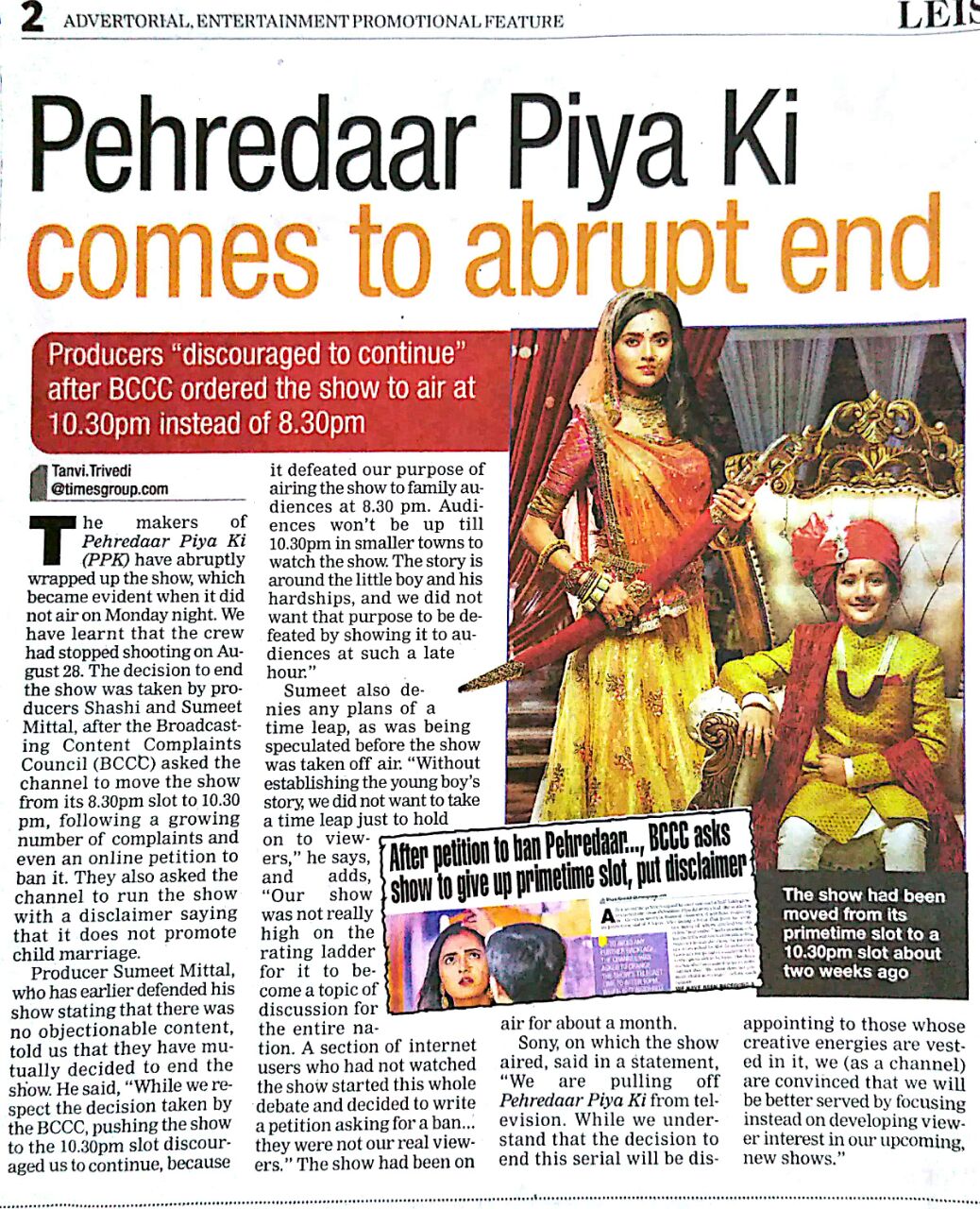
Pehredar piya ki


Pehredar piya ki

September,12,2017

   I m in suport of searial. I really like the concept
The show was about a young girl sacrificing her happines by marrying a much younger boy so she      can become his caretaker and protect him  from his evil family . It starred tejaswi prakash and affan khan in the lead role.


This story is about 18 years old girl and named ratansa married with diya she is 18 years old. This types of marriage. Gives wrong inspiration to our socity. Boy ratansa this matter .because of some reason diya marry to him.she wants to give protection to ratansa and take care to ratansa .so she marry with him. Marriage is only way to live with him and protect to him.


      Thanks


Friday, 8 September 2017

Pehredar piya ki

Pehredar piya ki

August 11, 2017
         

   I m in support of this searial. I really like the concept. 
The show was about a young girl sacrificing her happiness by marrying a much younger boy so she can become his caretaker and protect him from his evil family.  It starred Tejaswi prakash and affan khan in the lead role.


          This story is about 18 years old girl and 9 years old boy. In this story the boy whose named ratansa married with diya she is 18 years old. This types of marriage. gives wrong inspiration to our society. Boy Ratansa how can he gives protection not accepted this matter. Because of some reason diya marry to him. She wants  to give protection to Rtansa and take care to Rtansa. So she marry with him. Marriage is only way to live with him and protect to him.


             Thanks.

Paper no : 15 Assignment

Assignment Name: Mori Utsavi Bharatbhai Roll No. : 33 Enrolment No. : 2069108420180037 M.A.Sem: 4 Year: 2017-2019 Email id:...